
Cycling With Children in London
Cycling around London with children can be one of the best ways to spend a family day together. It gets everyone outside, gives children a chance to become more confident on two wheels, and turns an ordinary journey into a small adventure.
At the same time, cycling with children is very different from cycling alone. You have to think about traffic, road crossings, the child’s confidence, the condition of their bike and, perhaps most importantly, whether the route is suitable for the whole family.
London can look intimidating when you are cycling with younger riders, but careful planning can make a huge difference. With the right route, suitable bikes and a few sensible habits, family cycling can become something your children look forward to rather than something they worry about.
Choose the Right Route Before You Leave
One of the biggest mistakes parents can make is choosing a route based only on distance.
A five-mile route can be easy for an experienced cyclist but difficult for a child if it involves busy junctions, complicated roundabouts or roads with heavy traffic. Instead of asking, “How far is it?”, think about the entire journey.
Look for quieter streets, protected cycle routes, parks and routes away from heavy traffic. TfL highlights Cycleways as routes designed to connect different parts of London and recommends routes such as the Thames Path and Regent’s Canal for recreational riding.
For a first family ride, keep the distance short. You can always extend the journey if everyone is enjoying themselves. It is much better to finish a short ride with happy children asking when they can go again than to push too far and end the day exhausted.
It is also worth checking the route before setting off. Look for steep hills, road crossings, narrow sections and places where you can stop for a drink or snack.
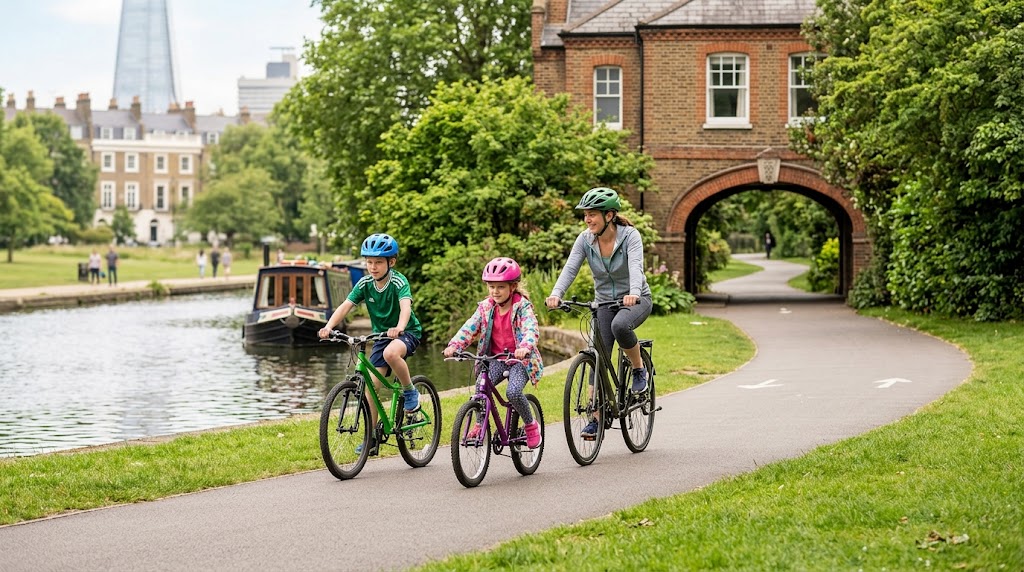
Start With Familiar Roads
Children become more confident when they know what to expect.
If your child is learning to ride on the road, begin somewhere familiar and relatively quiet. A local park or quiet residential area can be useful for practising braking, signalling, starting and stopping.
Once they are comfortable, introduce slightly busier routes one section at a time.
You do not need to turn every family ride into a cycling lesson. Instead, use everyday situations to teach simple habits. For example, ask your child to spot a junction before you reach it or explain why you are slowing down before a parked-car section.
Over time, these small conversations help children understand that cycling is not simply about pedalling. It is also about observing what is happening around them.
Make Sure Their Bike Fits Properly
A child can struggle on a bike that is too large, too heavy or poorly adjusted.
Before leaving home, check that your child’s saddle and handlebars are adjusted appropriately and that they can comfortably control the bike. Make sure the brakes work properly and that the tyres are inflated to the recommended pressure.
The Highway Code advises cyclists to make sure their cycle is the correct size and type, tyres are in good condition and properly inflated, wheels spin freely, gears work correctly and the saddle and handlebars are adjusted correctly. Efficient brakes are also a legal requirement.
Give the bike a quick check before every family ride. It only takes a couple of minutes and can prevent a small mechanical problem from turning into a major interruption halfway through your journey.
Get the Helmet Fit Right
A helmet should not simply sit on top of a child’s head.
It should be the correct size, positioned properly and securely fastened. The Highway Code recommends a cycle helmet that conforms to current regulations, is the correct size and is securely fastened. It also notes that evidence suggests a correctly fitted helmet can reduce the risk of certain head injuries.
Take a moment to check the fit before every ride, particularly if your child has recently grown.
It is also worth making sure other clothing is suitable. Loose straps, scarves or clothing that could catch in a wheel or chain should be avoided. Bright or fluorescent clothing can also help visibility during daylight, while reflective accessories can be useful in darker conditions.
Teach Children the Basics of Road Awareness
Children do not need to know every part of the Highway Code before their first family ride, but they should understand a few essential principles.
Teach them to look carefully before moving, communicate with you when they see something unusual and slow down when approaching junctions or other areas of uncertainty.
Explain why you are stopping rather than simply telling them to stop. For example:
“There’s a junction ahead, so we’re slowing down.”
“There’s a parked car, so we’re giving ourselves more space.”
“There’s a pedestrian crossing, so we’re checking carefully.”
These explanations help children understand the reason behind the action.
The Highway Code also advises cyclists to be considerate when riding in groups and specifically notes that riding two abreast can sometimes be safer when accompanying children or less experienced riders. Riders should still allow vehicles to overtake when it is safe to do so.
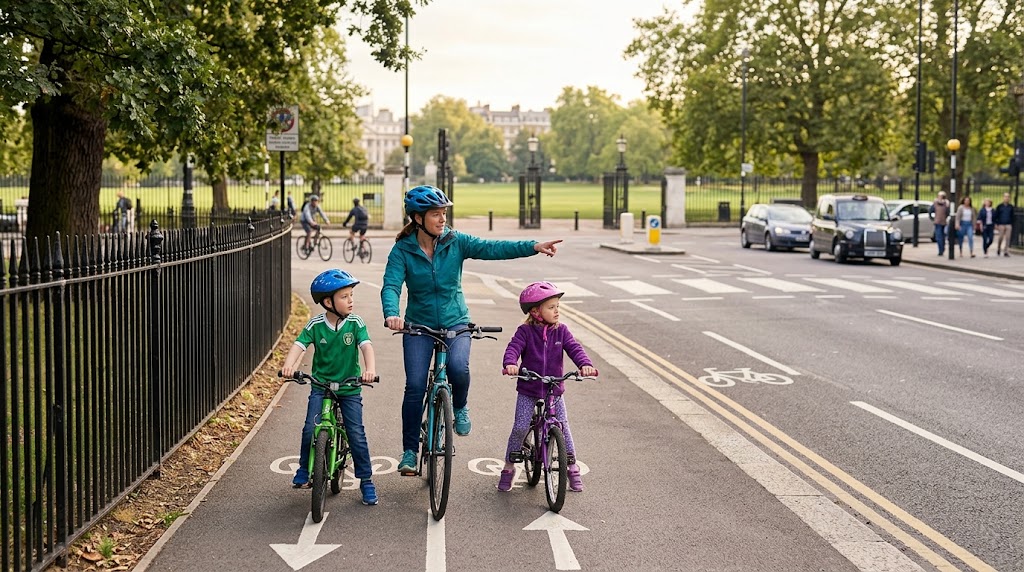
Keep an Eye on Traffic Around You
London traffic can change quickly.
Buses pull away from stops, taxis stop unexpectedly, pedestrians can cross without warning and parked vehicles can suddenly open their doors. Children may not recognise these risks as quickly as an experienced adult.
For this reason, parents should think about their position within the group.
A younger or less confident child may be more comfortable riding between adults, while older and more experienced children may be able to ride slightly ahead with clear instructions.
Do not assume your child will remember every instruction when something unexpected happens. Practise stopping, slowing down and communicating before you encounter busy traffic.
Consider a Child Seat, Trailer or Cargo Bike
Not every child is ready to ride their own bicycle around London.
For younger children, there are other ways to enjoy family cycling. Depending on the child’s age, size and the equipment manufacturer’s requirements, parents may consider a suitable child seat, trailer or cargo bike.
TfL’s guidance on choosing a cycle highlights child seats, trailers and cargo bikes as options for families who want to take children along on cycling journeys.
Whichever option you choose, follow the manufacturer’s instructions carefully and make sure the equipment is properly fitted before riding.
A short test ride in a quiet area is a good idea. You want to make sure the bike handles comfortably with the additional weight before heading into busier parts of London.
Pack More Than You Think You Need
Children have a remarkable ability to become hungry at exactly the point when you have travelled the furthest from home.
For longer rides, take water and a few simple snacks. A small first-aid kit can also be useful, along with basic bike tools and a spare inner tube if you know how to replace one.
TfL’s guidance for cycling trips recommends carrying a basic maintenance kit and first-aid kit, while also checking that bikes are roadworthy before a trip.
Do not forget weather protection either. London’s weather can change quickly, so a lightweight waterproof layer can be useful even when the morning looks promising.
Plan Regular Stops
Children are not interested in completing a route as quickly as possible.
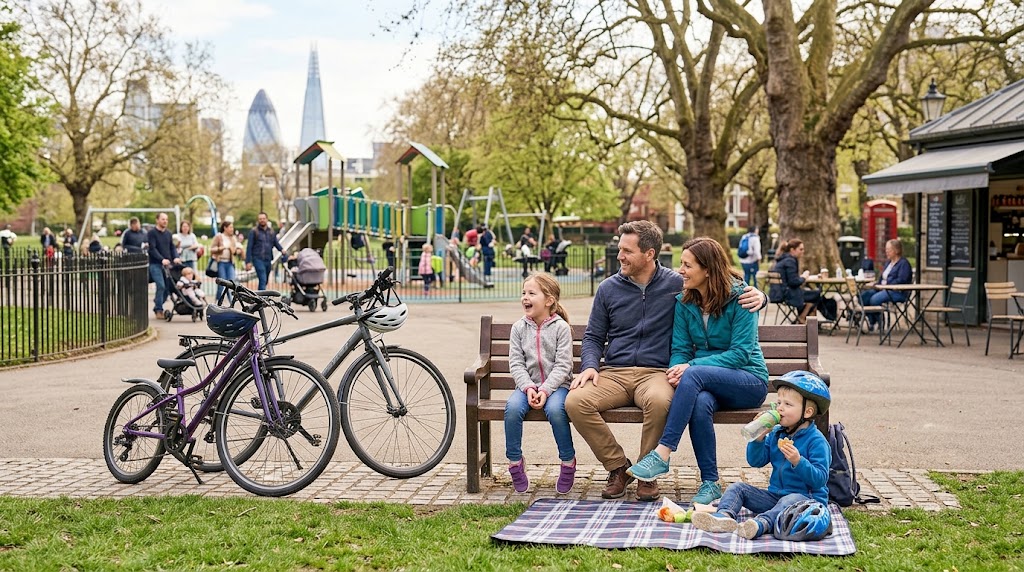
They may want to look at a duck, watch a boat, explore a playground or simply stop for an ice cream.
Build these moments into your journey.
Stopping regularly also gives everyone a chance to drink, have a snack and check that the children are still comfortable. A family ride does not need to be a training session. The goal is to enjoy being outside together.
If you are exploring a new area, consider choosing a destination rather than focusing on a particular mileage target. A park, café, playground or interesting landmark can give children something to look forward to.
Choose the Right Time of Day
Timing can make a noticeable difference to a family cycling trip.
If your children are nervous about traffic, consider riding at quieter times. TfL has noted that Sundays can offer a different rhythm on London’s streets, with lighter traffic making them useful for riders gaining confidence.
Early morning rides can also work well, although this depends on the route and weather.
Avoid creating unnecessary pressure by trying to squeeze a long cycling trip between other commitments. When everyone is rushing, mistakes become more likely and children can become anxious.
Give yourself plenty of time.
Make Safety Part of the Fun
Safety does not have to mean giving children a long list of frightening warnings.
Turn it into a game.
Ask them to spot road signs. Let them identify cycle lanes. Ask them when they think you should slow down. Teach them simple hand signals and practise them somewhere quiet.
You can even give children small responsibilities, such as checking that their helmet is fastened or reminding everyone to drink water.
The more involved they are, the more likely they are to remember the habits.
Remember that cyclists must follow the Highway Code. For example, cyclists must not ride on pavements except where specific legal provisions allow cycling, and bikes used at night must have the required front and rear lights.
Don’t Push a Nervous Child Too Far
Every child develops confidence at a different pace.
One child might happily ride through London after a few short trips, while another may need weeks or months of practice before feeling comfortable.
If your child is nervous, listen to them.
You can always shorten the route, walk a difficult section or choose a quieter area next time. Confidence grows through positive experiences, not pressure.
The most important thing is that children associate cycling with enjoyment, freedom and family time.
Make Family Cycling a Regular Adventure
The first ride does not have to be perfect.
You might get caught in a shower. Someone might get a puncture. Your child might decide halfway through the journey that they are suddenly starving. That is all part of cycling.
What matters is building experience.
Start locally, gradually explore further and allow your children to become involved in planning future rides. As their confidence grows, London opens up in a completely different way.
Instead of seeing the city from the back seat of a car or through a bus window, children can experience its parks, canals, streets and landmarks at their own pace.
Family cycling is not about how quickly you can get somewhere. It is about making the journey part of the experience.
Final Thoughts
Cycling with children in London takes a little more planning, but the rewards can be enormous. Choose suitable routes, keep bikes properly maintained, make sure helmets fit correctly, teach children simple road-awareness skills and give everyone plenty of time to enjoy the ride. Most importantly, keep the experience positive and suitable for your child’s age and confidence level. When your family needs help choosing, checking or maintaining bikes for everyday London riding, Camden Cycles can be part of your local cycling routine, helping you keep the family ready for the next ride around the city.