
Bike Lights Explained: What Do You Actually Need for London?
Cycling around London after dark can feel completely different from riding during the day. Busy junctions, buses pulling away from stops, parked cars, pedestrians crossing the road and cyclists moving in every direction all make visibility incredibly important. Add rain, fog or a dark winter evening, and a good set of bike lights becomes more than just another accessory.
But walk into a bike shop or browse online and you can quickly find yourself looking at hundreds of different lights. Front lights, rear lights, rechargeable lights, flashing lights, powerful beams, daytime running lights and lights with different brightness levels can make the choice confusing.
So, what do you actually need for cycling in London?
The answer is simpler than you might think.
You need a white front light, a red rear light and the appropriate reflectors when cycling at night. The Highway Code states that your front and rear lights must be lit after dark. Flashing lights are permitted, although a steady front light is recommended when riding in areas without street lighting.
However, there is a difference between having the legal basics and having lights that make your evening ride genuinely safer and more comfortable.
Why Bike Lights Matter So Much in London
London has plenty of street lighting, so it is easy to assume that bicycle lights are mainly there to help you see the road.
That is only half the story.
One of the biggest jobs of a bike light is helping other road users see you.
A driver turning at a junction might be looking for cars and pedestrians but fail to notice a cyclist approaching from the side. A pedestrian stepping into the road may not see a bicycle coming towards them. Even another cyclist can struggle to spot you in a busy, poorly lit street.
A good set of lights gives your bicycle a much more noticeable presence.
TfL also recommends keeping lights charged or carrying spare batteries and notes that poor weather and low light can reduce visibility even during the daytime.
Think of your lights as part of your communication with everyone around you. They tell people, “I am here.”
The Basic Setup: Front and Rear Lights
For most London cyclists, the starting point is simple.
1. White Front Light
Your front light should be white and positioned so that it can be seen clearly from the front.
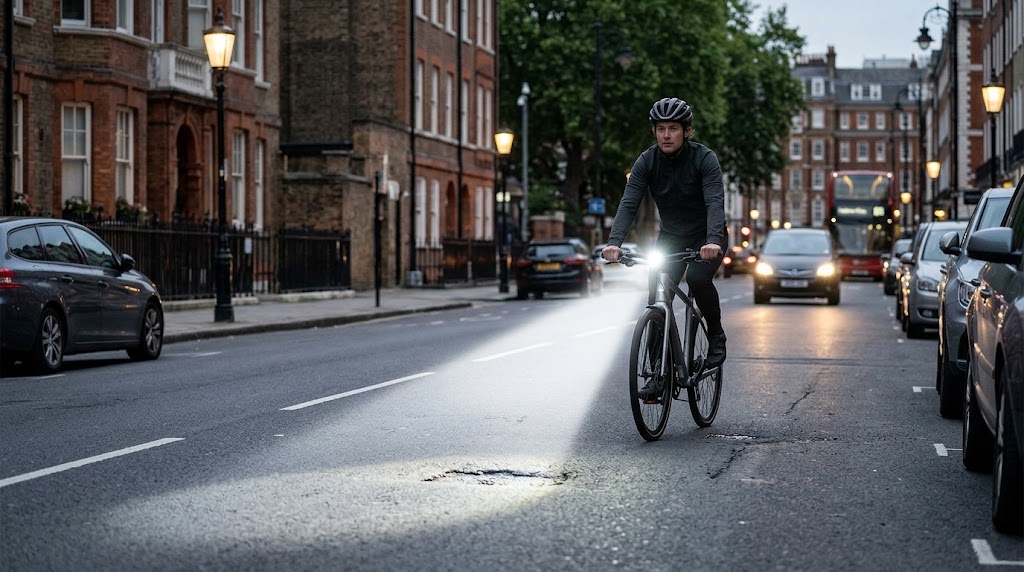
A basic front light can be enough for a well-lit commute where your main priority is being seen. If you regularly cycle along darker roads, parks or poorly lit sections, however, you will want something more powerful that helps illuminate the road ahead.
A good front light should allow you to:
- See potholes and road imperfections
- Spot parked vehicles and obstacles
- Make your position obvious to drivers
- See clearly when street lighting is limited
- Continue riding confidently in poor weather
Don’t automatically assume that the brightest light is the best light. A badly positioned, extremely bright beam can cause discomfort or glare for other road users.
The Highway Code says cyclists should not use lights in a way that dazzles or causes discomfort to other road users.
2. Red Rear Light
Your rear light is just as important as your front light.
It tells drivers, cyclists and pedestrians approaching from behind that you are on the road.
A small red rechargeable light can work perfectly well for everyday commuting, especially on roads with good street lighting. If you regularly cycle in darker areas, look for a rear light that is easy to see from a good distance and has a reliable battery.
Some cyclists prefer a steady rear light, while others use a flashing setting to attract attention.
The important thing is that it is visible, correctly positioned and working properly.
Do You Need Extremely Bright Lights?
This is where many cyclists get carried away.
You don’t necessarily need the most powerful light available.
If your usual journey takes you through central London with street lights almost all the way, your requirements are very different from someone cycling along an unlit canal path at 10pm.
Think about where you actually ride.
For a well-lit London commute
A moderate front light may be enough to make you visible while allowing you to see the road clearly.
For darker roads
A stronger front light becomes much more useful because you need to see the surface ahead rather than simply be seen.
For parks, canals and unlit routes
A powerful front beam can make a significant difference. You will want enough light to identify potholes, uneven surfaces, pedestrians and other hazards before you reach them.
The Highway Code specifically recommends a steady front lamp when cycling in areas without street lighting.
Flashing or Steady: Which Is Better?
There is no need to choose one setting for every situation.
Flashing lights are permitted on bicycles, and they can attract attention in busy urban environments.
However, a steady light can be easier for other road users to judge, particularly at the front.
For example, you might use:
Front: steady beam
Rear: flashing or steady setting
Or you may choose steady lights at both ends.
The key point is visibility without creating glare or confusion.
If you are riding somewhere with no street lighting, a steady front beam is particularly useful because you need to illuminate the road rather than simply announce your presence.
How Bright Should Your Front Light Be?
Instead of obsessing over one number, think about the environment.
A light that works brilliantly for a short daytime commute may be disappointing on a dark country lane.
For London, consider these general categories:
Low-powered lights:
Useful mainly for being seen on already well-lit streets.
Medium-powered lights:
A good all-round option for commuting and general evening riding.
High-powered lights:
Better for cyclists who regularly use darker roads, towpaths or poorly lit routes.
Remember that brightness is only one part of the equation. Beam shape, battery life, mounting position and weather resistance can be just as important.
A light that claims impressive brightness but lasts only a short time may not be much use if your journey home is longer than expected.

Don’t Forget Battery Life
Imagine leaving work on a dark winter evening, getting halfway home and suddenly seeing your front light start flashing because the battery is almost empty.
Not ideal.
Rechargeable lights are convenient, but they need regular charging. Make charging your lights part of your routine, just like charging your phone.
If you use your bicycle every day, check:
- How long the battery lasts on your chosen setting
- How quickly it recharges
- Whether the light shows a low-battery warning
- Whether you can easily remove it for charging
- Whether you can carry a backup light
For longer journeys, carrying a small spare light can be a sensible precaution.
Where Should You Mount Your Lights?
A good light in the wrong position can still cause problems.
Your front light should be securely attached to the handlebars or appropriate mounting point and aimed so that it illuminates the road without shining directly into people’s eyes.
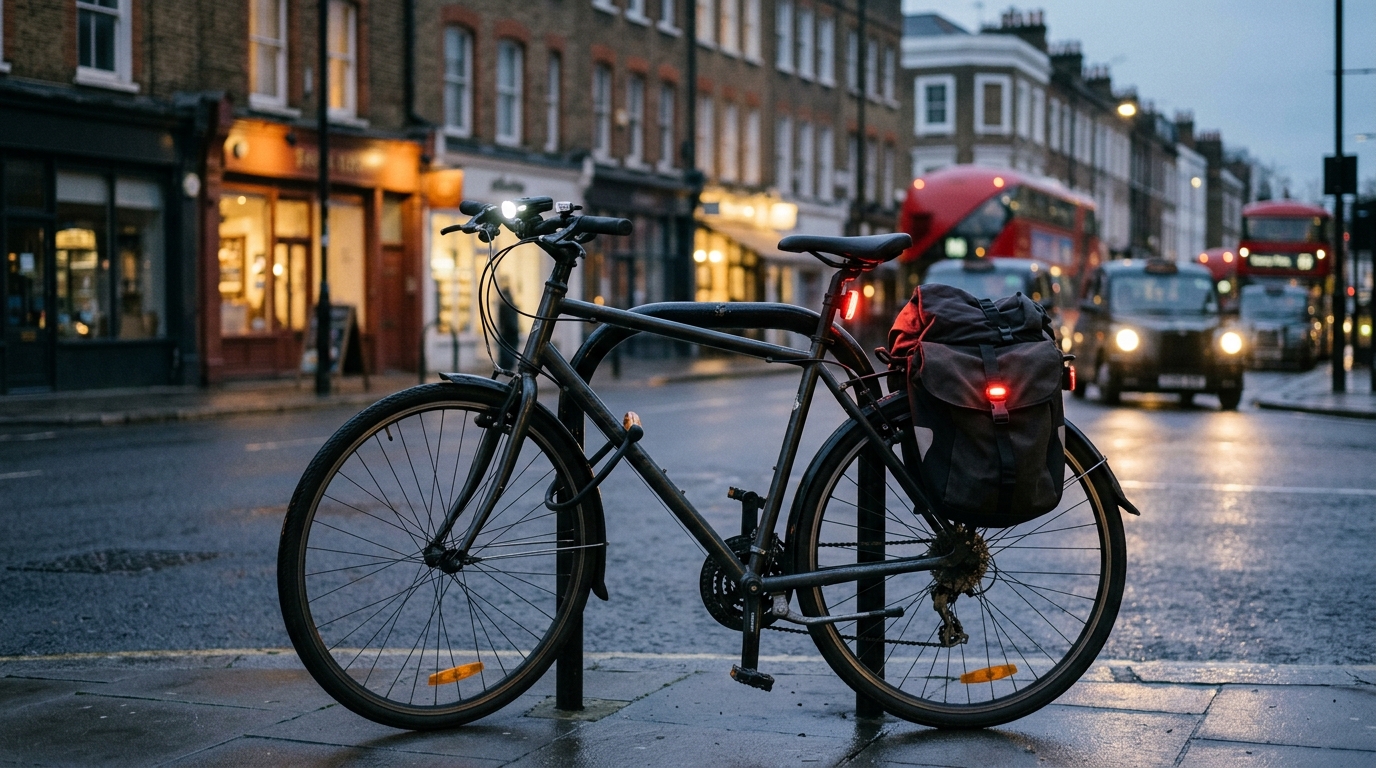
Your rear light should be positioned where it can be clearly seen from behind.
Avoid placing lights where they can easily be covered by:
- A backpack
- A jacket
- A basket
- A pannier
- Loose straps
This is particularly important for commuters. You might carefully attach your rear light before leaving home, then put a large backpack on and unknowingly block half of it.
Take a quick look at your bike from behind before setting off.
What About Reflectors?
Lights and reflectors are not exactly the same thing.
The Highway Code states that a bicycle used at night must have a red rear reflector and the required pedal reflectors, with additional front and spoke reflectors helping visibility.
Reflective equipment can be especially useful because it works when illuminated by another person’s headlights.
You can also improve your visibility with reflective clothing, ankle bands or other reflective accessories. The Highway Code notes that reflective clothing and accessories can increase visibility in darkness.
Should You Use Bike Lights During the Day?
You don’t have to wait until it is completely dark to think about visibility.
London weather can change quickly. Heavy rain, fog, dull winter afternoons and low sunlight can make cyclists harder to see.
Using lights during the day can make your bike more noticeable, particularly on busy roads.
Some modern bike lights have dedicated daytime modes designed specifically to attract attention without draining the battery too quickly.
For commuters who spend a lot of time around traffic, using lights during the day can be a worthwhile habit.
A Simple London Bike Light Setup
If you don’t want to overcomplicate things, start with this:
Front:
A reliable white rechargeable light with enough power for your normal routes.
Rear:
A red rechargeable light that remains clearly visible from behind.
Reflectors:
Keep the required reflectors fitted and clean.
Backup:
Carry a small spare light or make sure your phone and journey plan are not your only backup if your main light fails.
Charging routine:
Charge your lights regularly rather than waiting until they are almost empty.
This setup is enough for most everyday London cyclists.
Common Bike Light Mistakes to Avoid
Even expensive lights won’t help much if they’re used incorrectly.
Using a nearly empty battery
A light that switches off halfway through your journey is no better than having no light at all.
Pointing the front light directly at people
A powerful light should illuminate your path, not blind approaching cyclists, pedestrians or drivers.
Covering the rear light
Check that bags, jackets and panniers aren’t blocking it.
Using only a tiny front light on dark routes
A small visibility light may be fine on a bright, well-lit street, but it may not provide enough illumination on an unlit route.
Never checking the mount
A loose light can slowly point towards the ground or move sideways during a ride. Give it a quick check before setting off.
The Best Light Is the One You Actually Use
You don’t need to spend a fortune creating a professional racing setup for a five-mile commute.
The best bike light is one that suits your route, remains securely attached to your bicycle, has enough battery life for your journey and helps you remain visible.
For a typical London cyclist, the priority should be straightforward: white at the front, red at the rear, good visibility, sensible brightness and a reliable battery.
And don’t forget that lights are only one part of safe night riding. Your brakes, tyres, reflectors and other equipment should also be kept in good working condition. The Highway Code advises cyclists to keep lights and reflectors clean and working properly, as well as ensuring the brakes and other important parts of the bicycle are in good condition.
Final Thoughts
London cycling doesn’t stop when the sun goes down. Whether you’re heading home from work, meeting friends in Camden or simply enjoying an evening ride, the right lights can make the experience much more comfortable.
Don’t choose your lights simply because they have the biggest number on the box. Think about your route, how dark it gets, how long your journeys normally take and how visible you need to be around traffic.
A dependable front light, a clear red rear light, suitable reflectors and a little preparation before every ride can go a long way.
If you’re unsure which lights, reflectors or other cycling accessories are right for your bike and the type of riding you do around London, Camden Cycles can help you choose practical equipment that suits your everyday cycling needs.